
Motorcycle safety depends on more than wearing a helmet, following traffic laws, and keeping a safe distance from other vehicles. A rider’s ability to slow down quickly while maintaining control can make the difference between avoiding a collision and experiencing a serious crash. This is why motorcycle anti-lock braking systems, commonly known as ABS, have become one of the most important safety features to consider when purchasing a modern street motorcycle.
Whether you commute through busy city streets, ride on interstate highways, travel through mountain passes, or enjoy weekend trips along rural roads, understanding motorcycle ABS can help you make informed decisions about your equipment and riding habits. The technology is designed to help prevent a wheel from locking during hard braking, reducing the chance of losing control when a rider must respond to an unexpected hazard.
Imagine traveling on a suburban road when a car suddenly turns across your path. You immediately apply the brakes, but the road is slightly damp and the available stopping distance is limited. If you apply excessive braking pressure, a wheel on a motorcycle without ABS may lock and begin to skid. On an ABS-equipped motorcycle, the system can detect an impending wheel lock and automatically adjust brake pressure to help maintain wheel rotation.
That intervention can make a meaningful difference, but ABS is not a guarantee against crashes. It cannot create traction where there is none, compensate for excessive speed, or eliminate the need for good judgment. Riders still need to understand how their motorcycles behave, recognize hazards early, maintain their brakes and tires, and practice emergency braking in a controlled environment.
This comprehensive guide explains how motorcycle ABS works, what research says about its safety benefits, how it behaves on different road surfaces, and what American riders should consider when choosing and maintaining an ABS-equipped motorcycle.
What Is Motorcycle ABS?
Motorcycle ABS is an electronic braking system designed to reduce the likelihood of wheel lockup during hard braking. Wheel lockup happens when braking force exceeds the grip available between a tire and the road, causing the wheel to stop rotating even though the motorcycle is still moving forward.
A locked motorcycle wheel can create a serious stability problem. A locked front wheel is particularly dangerous because the front tire provides a substantial share of braking force and helps maintain directional control. A locked rear wheel can slide sideways, potentially causing the motorcycle to become unstable or making recovery difficult.
A conventional braking system depends largely on the rider to regulate brake pressure. Skilled riders learn to apply the brakes firmly without exceeding the tire’s available traction. However, emergency situations are unpredictable, and a rider may instinctively grab the brake lever or press the pedal too hard.
ABS adds an automatic layer of protection. It monitors wheel rotation and adjusts brake pressure when the system detects that a wheel is approaching lockup. This can help preserve traction and stability during a sudden stop.
Why Wheel Lockup Is Dangerous
Motorcycles rely on two relatively small tire contact patches to support the bike, provide braking force, and maintain control. When a wheel locks, the tire may lose its ability to provide the grip needed for stable braking and steering.
Consider a rider approaching a busy intersection at 35 mph. A vehicle suddenly pulls out from a side street, leaving little time to react. The rider applies the front brake aggressively. If the front tire locks, the motorcycle may lose stability before the rider can correct the situation. If the rear tire locks, the back of the motorcycle may begin sliding sideways.
A trained rider may recover from some braking mistakes, but recovery is not always possible, especially when the hazard appears suddenly or the road surface is slippery.
ABS helps reduce the risk by automatically adjusting hydraulic pressure when a wheel approaches lockup. It does not eliminate every skid or guarantee that the rider will avoid an impact, but it can help maintain control during demanding braking situations.
What ABS Does and Does Not Do
The purpose of motorcycle ABS is specific: it helps prevent the wheels from locking during braking. It does not automatically detect every road hazard, steer around vehicles, or choose a safe speed for the rider.
An ABS-equipped motorcycle still requires good tires, functioning brakes, appropriate suspension, and a rider who understands how to operate the controls. If a rider enters a corner too quickly, follows another vehicle too closely, or rides on ice, ABS cannot make the situation safe.
The best way to think about ABS is as an additional safety system that helps manage one important crash risk. It works alongside defensive riding, protective equipment, and regular motorcycle maintenance.
 How Motorcycle ABS Works
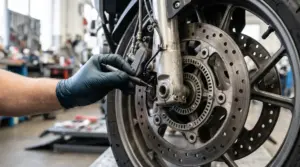
Motorcycle ABS combines mechanical braking components with electronic monitoring and hydraulic control. The system continuously checks wheel behavior while the motorcycle is moving and intervenes when braking threatens to lock a wheel.
Although specific designs differ by manufacturer, most systems use wheel-speed sensors, sensor rings, an electronic control unit, and a hydraulic modulator.
Wheel-Speed Sensors Monitor the Wheels
Wheel-speed sensors measure how quickly the wheels rotate. Many motorcycle systems use toothed or slotted rings mounted near the wheels. As a wheel turns, a sensor detects changes in the ring’s position and sends signals to the control unit.
The control unit uses this information to evaluate wheel speed and deceleration. During ordinary braking, the wheels continue rotating in a way that does not require ABS intervention. When a wheel slows unusually quickly and approaches lockup, the system can respond.
These sensors need to be in good condition to provide reliable information. Damaged sensor rings, incorrect installation, wiring problems, or other faults may affect ABS operation.
The Electronic Control Unit Evaluates Braking
The ABS control unit processes the information received from the sensors. It monitors wheel behavior and determines when brake pressure may need to be adjusted.
For example, imagine a rider traveling at 45 mph on a dry road who suddenly encounters stopped traffic. The rider applies firm braking pressure, and the front wheel begins decelerating rapidly. If the system detects an impending lockup, it can instruct the hydraulic modulator to reduce pressure before the wheel stops rotating.
Once wheel rotation recovers, the system can increase pressure again. This process can repeat rapidly during the braking event.
The rider does not have to manually perform these pressure adjustments. The system is designed to intervene automatically when needed.
The Hydraulic Modulator Adjusts Brake Pressure
The hydraulic modulator controls brake pressure in response to commands from the ABS control unit. Depending on the design, it can reduce pressure, hold it temporarily, or increase it again.
A rider may feel pulsing or vibration through the brake lever or pedal when ABS activates. Some motorcycles also produce a buzzing or clicking sound during intervention. These sensations may be normal, but riders should consult their owner’s manual to understand what to expect on their particular model.
If the brakes behave unusually, or an ABS warning light remains illuminated, the motorcycle should be inspected rather than assuming every sensation is normal.
Why ABS Can Respond Faster Than a Human Rider
When a rider realizes a wheel is locking, they must recognize the problem and adjust their brake input. In an emergency, this can be difficult because the rider is simultaneously trying to avoid a collision, maintain balance, and assess surrounding traffic.
ABS automates one part of that process. The system can monitor wheel behavior and adjust brake pressure repeatedly without requiring the rider to consciously recognize each potential lockup.
This does not mean electronics can solve every emergency. The system only works within the limits of its design and the traction available. Nevertheless, its ability to respond automatically is a major reason ABS can be beneficial in real-world riding.
Does Motorcycle ABS Actually Prevent Crashes?
Research indicates that motorcycle ABS is associated with a meaningful reduction in fatal crash risk. One of the most frequently cited findings comes from the Insurance Institute for Highway Safety (IIHS), which compared motorcycles offered with and without optional ABS.
The IIHS research found that motorcycles equipped with optional ABS had a 22% lower rate of fatal crash involvement than comparable versions without ABS, measured per 10,000 registered vehicle years. The study examined 65 motorcycle models using fatal-crash data from 2003 through 2019.
This finding is important because it reflects real-world crash outcomes rather than relying solely on laboratory tests. The research does not mean that ABS will reduce every individual rider’s risk by exactly 22%, but it supports the conclusion that the technology can make an important contribution to motorcycle safety.
For the research and additional findings, see the Insurance Institute for Highway Safety’s motorcycle ABS research.
Why Real-World Research Matters
Controlled tests can demonstrate how a braking system responds under specific conditions, but real-world riding includes variables that are difficult to reproduce consistently. Traffic may behave unpredictably, pavement may be contaminated, and riders may have only a fraction of a second to respond.
Crash research helps show whether a technology’s benefits extend beyond a test track. In the case of motorcycle ABS, studies of fatal crashes and insurance claims have found evidence of improved safety outcomes.
However, research findings must be interpreted carefully. Crash rates can differ according to motorcycle type, rider behavior, road conditions, and other factors. ABS is not equally effective in every possible crash scenario, and the system cannot eliminate all causes of motorcycle accidents.
How ABS Helps During an Unexpected Stop
Consider a rider commuting on a multilane road. Traffic ahead suddenly slows because a vehicle is merging into a crowded lane. The rider has little time to react and must brake more firmly than expected.
On a motorcycle without ABS, excessive pressure may cause a wheel to lock. On a motorcycle with functioning ABS, the system can intervene to reduce the risk of lockup, helping the rider maintain usable wheel rotation while slowing.
This added assistance can be especially valuable when a rider is surprised and cannot smoothly regulate brake pressure.
The benefit is not limited to inexperienced motorcyclists. Even riders with years of experience can encounter sudden hazards, wet pavement, unexpected debris, or other conditions that make emergency braking difficult.
Why Experienced Riders Benefit Too
Experienced riders often develop excellent braking skills, but skill does not remove every risk. A veteran motorcyclist may still be surprised by a vehicle that turns across their path, a patch of gravel in a corner, or an abrupt traffic slowdown.
Fatigue, distraction, weather, and road design can also affect a rider’s ability to respond. ABS provides additional support when the rider must brake hard and a wheel approaches lockup.
Good technique remains essential, but choosing a motorcycle with ABS can provide an extra layer of protection that does not depend entirely on the rider reacting perfectly every time.
How Motorcycle ABS Performs on Different Road Surfaces
Motorcyclists encounter many types of pavement and weather conditions during everyday rides. A commute may include dry asphalt, wet intersections, painted lane markings, construction debris, and shaded roads that remain cold long after the surrounding area warms up.
ABS can help in many of these situations, but it cannot overcome every traction problem. Understanding its limitations is just as important as understanding its benefits.
Braking on Dry Pavement
Dry, clean pavement usually provides favorable traction, allowing a motorcycle’s tires to generate substantial braking force. Under predictable conditions, a skilled rider may be able to brake firmly without activating ABS.
However, emergencies do not always allow for a smooth, planned stop. If a car suddenly stops in front of a motorcyclist, the rider may apply the brakes more aggressively than intended. ABS can help reduce the chance of wheel lockup when braking force approaches the available grip.
Imagine traveling at 40 mph on a suburban road when a vehicle abruptly stops before a pedestrian crossing. A rider who has maintained a safe following distance may have enough room to stop without difficulty. If the available distance is limited, ABS can help manage the risk of a locked wheel during firm braking.
The system does not guarantee that the motorcycle will stop before reaching the vehicle. Stopping distance still depends on speed, reaction time, tires, pavement condition, braking technique, and the performance of the motorcycle’s braking system.
 Braking on Wet Roads
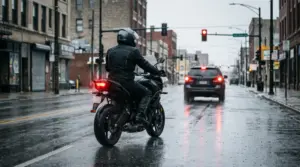
Rain reduces tire grip and can make emergency braking more challenging. Oil residue, dirt, worn pavement, and water collecting near intersections may create additional hazards.
ABS can help prevent a wheel from locking when a rider applies firm braking pressure on wet pavement. This may improve the rider’s ability to maintain control while slowing down.
Nevertheless, wet-weather riding requires extra caution. A motorcycle traveling too fast for the conditions may not have enough distance to stop, even when ABS works correctly. Standing water can also cause a loss of tire contact, while slippery markings and metal covers may provide less grip than the surrounding pavement.
When riding in rain, increase your following distance, reduce speed, avoid abrupt steering inputs, and anticipate traffic changes. If visibility becomes poor or the road is flooded, find a safe place to stop until conditions improve.
Braking on Gravel and Loose Dirt
Loose gravel, sand, and dirt behave differently from clean pavement. The material can move beneath the tire, reducing the grip available for braking and steering.
Depending on the motorcycle’s design and ABS calibration, the system may prevent the wheel from slowing as much as a rider might otherwise achieve on a loose surface. In some circumstances, this can increase stopping distance.
Some adventure and dual-sport motorcycles provide specialized off-road ABS settings. These may permit additional wheel slip or allow different levels of intervention at the front and rear wheels. Features vary considerably, so riders should not assume that every motorcycle offers the same capabilities.
On unpaved roads, reduce speed before entering loose sections and avoid sudden braking or steering. If you regularly ride gravel roads or trails, seek instruction appropriate to your motorcycle and the conditions you expect to encounter.
Braking on Painted Lines and Metal Covers
Painted lane markings, steel road plates, manhole covers, bridge joints, and metal utility covers can become slippery, especially when wet. These surfaces are common in cities and construction zones.
ABS can help reduce wheel-lock risk if braking causes a wheel to approach lockup, but it cannot guarantee traction when the tire crosses a slippery surface. Abrupt steering or sudden changes in brake pressure may still destabilize the motorcycle.
Look ahead for these hazards and adjust your speed before reaching them. When crossing a slick marking or metal surface, keep your inputs smooth and avoid unnecessary movements. Do not use ABS as a reason to brake aggressively on a surface with limited grip.
Braking in Cold Weather
Cold temperatures can affect tire performance, while shaded roads, bridges, and elevated sections may remain colder than nearby pavement. Ice can make braking and steering extremely difficult.
ABS may help manage wheel lockup when some traction remains, but it cannot compensate for a complete or near-complete loss of grip on ice. The same limitation applies when a tire encounters other extremely slippery surfaces.
During colder months, pay attention to overnight temperatures, shaded corners, and changing weather. Allow more stopping distance and avoid riding when ice or freezing precipitation makes conditions unsafe.
Front Brake vs. Rear Brake: What ABS Riders Need to Know
Motorcycle braking differs from braking in a typical passenger car. Many motorcycles have separate controls for the front and rear brakes, requiring the rider to understand how each contributes to deceleration.
ABS can help manage wheel lockup, but it does not remove the need for proper braking technique.
Why the Front Brake Provides Much of the Stopping Force
When a motorcycle slows down, weight transfers toward the front wheel. This increases the load on the front tire and generally allows it to provide a substantial share of the braking force.
The front brake is therefore essential to effective stopping on most street motorcycles. However, applying it abruptly can exceed the tire’s available grip, particularly on a slippery surface or while the motorcycle is leaned over.
Riders should learn to apply front brake pressure progressively, allowing the suspension and tire to respond as the braking force increases. ABS can help reduce the risk of front-wheel lockup, but it does not make abrupt inputs harmless.
For example, a rider approaching a red light may need to stop quickly because traffic ahead has slowed unexpectedly. Smooth, controlled braking helps the motorcycle remain stable while reducing speed. If ABS activates, the rider should follow the braking technique specified by the manufacturer rather than attempting to pump the controls.
Why the Rear Wheel Can Lock During Hard Braking
During strong deceleration, the rear wheel becomes less heavily loaded as weight transfers toward the front. This can make the rear tire easier to lock if the rider applies excessive rear brake pressure.
A locked rear wheel may slide sideways or cause the motorcycle to become unstable. Although some experienced riders can manage a rear-wheel slide in particular circumstances, deliberately creating one is not an appropriate emergency strategy for most street riders.
Rear ABS can help reduce the risk of lockup by regulating brake pressure. This is particularly useful for riders who are still developing smooth control of both brakes.
Should You Pump the Brakes on an ABS Motorcycle?
Generally, riders should not deliberately pump the brake lever or pedal on a motorcycle with functioning ABS. The system is designed to make rapid pressure adjustments automatically.
Instead, follow the motorcycle manufacturer’s instructions for emergency braking and practice applying firm, controlled pressure. If ABS intervenes, allow the system to perform its intended function rather than trying to imitate the manual pumping technique sometimes taught for vehicles without anti-lock brakes.
The exact technique depends on the motorcycle and the riding situation. A certified motorcycle safety course provides an appropriate environment to learn how the brakes feel and how to respond when ABS activates.
Motorcycle ABS vs. Conventional Brakes
Conventional motorcycle brakes can work effectively when used correctly, but they generally do not automatically regulate hydraulic pressure to prevent wheel lockup.
With conventional brakes, the rider must recognize the limits of available traction and adjust pressure accordingly. If a wheel locks, the rider may need to release some pressure and reapply it carefully, depending on the circumstances and their training.
With ABS, wheel-speed sensors monitor rotation, and the system adjusts brake pressure when a lockup is imminent. This can reduce the chance of a skid caused by excessive braking force.
| Feature | Conventional brakes | Motorcycle ABS |
|---|---|---|
| Basic braking function | Slows the motorcycle through friction | Slows the motorcycle through friction |
| Wheel-speed monitoring for anti-lock control | Generally absent | Included |
| Automatic pressure adjustment to reduce wheel lockup | No | Yes |
| Emergency braking support | Relies heavily on rider modulation | Helps reduce wheel-lock risk |
| Requires appropriate technique | Yes | Yes |
| Prevents every crash | No | No |
ABS is an additional safety feature, not a replacement for a properly maintained braking system. Brake pads, rotors, tires, suspension, and rider technique still influence stopping performance.
Standard ABS and Advanced Braking Technology
Not all anti-lock systems operate in exactly the same way. Some motorcycles have standard ABS, while others offer cornering ABS or different modes intended for off-road riding.
Standard ABS monitors wheel rotation and regulates brake pressure when a wheel approaches lockup. Cornering ABS may use additional information about the motorcycle’s lean and movement to adapt intervention during braking in a turn.
Some adventure motorcycles also provide off-road settings that permit more wheel slip or alter how the system responds on loose surfaces. These settings are model-specific, and riders should understand which wheels remain protected before changing them.
When comparing motorcycles, read the equipment specifications carefully. A model with cornering ABS may offer capabilities beyond standard ABS, but neither system eliminates the need to ride within the limits of tire grip.
How to Brake Safely During an Emergency
Emergency braking is a skill that should be practiced before a rider needs it in traffic. Understanding what to do can help reduce panic and improve decision-making when a hazard appears unexpectedly.
Recognize Hazards Early
Effective braking begins with observation. Scan far enough ahead to identify developing traffic problems, intersections, road debris, and vehicles that may turn across your path.
In urban areas, watch for cars entering from parking lots, drivers waiting to turn left, pedestrians near crosswalks, and vehicles braking abruptly. On highways, monitor traffic several vehicles ahead rather than focusing only on the car directly in front of you.
Early recognition gives you more time to reduce speed gradually. Avoiding an emergency stop altogether is often safer than relying on ABS to manage one.
Apply Firm, Controlled Braking
When a hazard requires a rapid stop, use the braking technique recommended for your motorcycle. In general, apply the brakes progressively rather than grabbing the front brake abruptly.
On a motorcycle with functioning ABS, do not deliberately pump the brakes. Maintain appropriate braking input and allow the system to regulate pressure when intervention is necessary.
The correct response depends on the road surface, motorcycle design, and available space. A rider who needs to stop behind traffic faces a different problem from someone who must avoid an obstacle. Formal training can help riders understand these situations and develop appropriate responses.
Keep the Motorcycle Stable
Hard braking changes the motorcycle’s balance and suspension behavior. Abrupt steering or unnecessary movements during a stop can make the situation more difficult to control.
When possible, brake with the motorcycle relatively upright and use smooth control inputs. If an obstacle requires evasive action, the correct response depends on the space available and your training. Do not assume that maximum braking and maximum steering can always be combined without exceeding available traction.
ABS is a braking aid, not an automatic obstacle-avoidance system. It cannot decide whether stopping or steering around a hazard is the better option.
Practice in a Controlled Environment
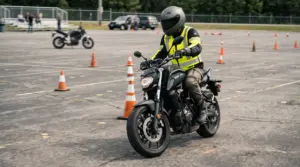
Reading about emergency braking is not the same as performing it. Riders should practice in a suitable training environment with qualified instruction, adequate space, and a surface appropriate for the exercise.
A motorcycle safety course can help riders understand brake feel, weight transfer, stopping distance, and how ABS behaves during intervention.
Do not experiment with panic stops in traffic or on public roads. If you are unfamiliar with your motorcycle’s ABS, ask a qualified instructor to explain the system and help you practice safely.
Does Motorcycle ABS Always Shorten Stopping Distance?
One of the most common questions riders ask is whether ABS always allows a motorcycle to stop in a shorter distance. The answer depends on the road surface, tires, motorcycle design, and rider input.
ABS can help riders achieve effective braking by reducing wheel lockup and preserving usable traction. Research summarized by IIHS reports improved stopping performance on wet and dry test surfaces for riders using ABS. However, stopping distance is not identical in every situation, and some loose surfaces can produce different results depending on the system’s calibration.
Reaction Time Still Matters
Total stopping distance includes the distance traveled while the rider recognizes a hazard and reacts, plus the distance required for the motorcycle to slow to a stop.
At 60 mph, a motorcycle travels approximately 88 feet every second. If the rider takes 1.5 seconds to react, the motorcycle travels about 132 feet before meaningful braking begins.
ABS does not reduce this initial reaction distance. It helps manage braking after the rider applies the brakes.
This is why following distance, visibility, and hazard awareness remain essential. A rider who follows another vehicle too closely may not have enough room to stop, even with a well-maintained ABS-equipped motorcycle.
Speed Has a Major Effect on Stopping Distance
The faster a motorcycle travels, the more energy its brakes must dissipate to bring it to a stop. Under comparable conditions, braking distance generally increases substantially as speed rises.
A rider traveling at 60 mph should not assume the motorcycle can stop in the same distance it would need at 30 mph. Higher speeds also leave less time to recognize hazards and respond.
Maintain a speed that allows you to react to the road ahead. ABS is not a reason to follow traffic more closely or ride faster than the conditions allow.
Tire Condition Affects Braking Performance
ABS cannot compensate for worn tires, incorrect tire pressure, damaged tread, or unsuitable tires. A tire with limited grip gives the braking system less traction to work with.
Check tire pressure according to the manufacturer’s recommendations, inspect the tread and sidewalls, and replace tires that have reached their service limits. Use tires that meet the motorcycle manufacturer’s specifications.
A motorcycle with advanced ABS but poor tires may still have inadequate braking performance. Good maintenance and responsible riding are essential regardless of the technology installed.
Common Motorcycle ABS Myths
Misunderstandings about ABS can lead riders to misuse the technology or underestimate its limitations. Understanding the facts helps motorcyclists make better safety decisions.
Myth 1: ABS Means You Cannot Crash During Hard Braking
Fact: ABS reduces the risk of wheel lockup, but it cannot prevent every crash.
A motorcycle may still collide with a vehicle if the rider has insufficient stopping distance. ABS cannot guarantee traction on ice, prevent every slide on loose gravel, or protect a rider who enters a corner too quickly.
It also cannot eliminate hazards caused by other road users. A driver turning directly across a motorcycle’s path may leave too little space for any braking system to prevent an impact.
Myth 2: ABS Is Only Useful for Beginner Riders
Fact: Riders at every experience level can encounter situations that exceed their ability to brake smoothly.
An experienced rider may have excellent technique but still face a sudden hazard that demands immediate action. ABS can help manage excessive brake pressure when the rider has little time to respond.
Experience is valuable, but it does not make a motorcyclist immune to surprise, fatigue, or changing road conditions.
Myth 3: ABS Always Stops a Motorcycle Faster
Fact: ABS helps prevent wheel lockup, but it does not guarantee the shortest possible stop in every environment.
Loose gravel, sand, and certain unpaved surfaces can produce different results depending on the motorcycle and its ABS calibration. The system’s primary benefit is reducing the risk of wheel lockup, not guaranteeing a specific stopping distance.
Myth 4: ABS Requires No Maintenance
Fact: ABS is part of the motorcycle’s braking system and needs to be kept in good working order.
Damaged sensors, wiring problems, hydraulic faults, or other failures can affect operation. Riders should not ignore warning lights or assume that ABS is functioning simply because the conventional brakes still work.
Follow the manufacturer’s maintenance schedule and have warning indicators or unusual braking behavior checked by a qualified technician.
Myth 5: ABS Makes Careless Braking Safe
Fact: ABS cannot override the physical limits of tire traction.
It does not provide extra grip beyond what the tires and road can support. It cannot guarantee stability during aggressive steering or make excessive speed safe.
The system works best when combined with smooth inputs, sensible speed, adequate following distance, and awareness of the surrounding environment.
How to Tell Whether Your Motorcycle Has ABS
If you are buying a used motorcycle or checking a bike you already own, do not assume it has ABS simply because it is a modern model or has large brake discs.
The most reliable starting point is the owner’s manual and the manufacturer’s specifications for the exact year, make, model, and trim.
Check the ABS Warning Light
Many ABS-equipped motorcycles have a dedicated dashboard indicator. The light may illuminate when the ignition is switched on as part of a self-check. On many models, it turns off after the motorcycle begins moving and the system completes its checks.
Indicator behavior varies by motorcycle. If the light remains illuminated or comes on while riding, consult the owner’s manual. It may indicate a fault or a condition that prevents normal ABS operation.
Do not assume the warning light is harmless just because the conventional brakes still function.
Inspect the Wheel Sensors
Many ABS-equipped motorcycles have a sensor and a slotted or toothed ring near one or both wheels. These components can help identify the presence of ABS, but their appearance alone does not prove that the system is functioning correctly.
If you are unsure, ask a qualified motorcycle technician to inspect the bike.
Verify the Exact Model Specification
Manufacturers sometimes sell the same motorcycle in versions with different equipment. ABS may be standard on one trim, optional on another, or unavailable on some versions.
When buying used, compare the model specifications, review the service history, and confirm that the system is present and operational. Do not rely solely on a seller’s description.
Is Motorcycle ABS Required in the United States?
Motorcycle equipment requirements vary internationally. In the United States, ABS is available on many street motorcycles, but it is not universally required on all motorcycles sold for road use.
This means buyers need to pay attention to equipment specifications rather than assuming every new motorcycle includes anti-lock braking.
The IIHS motorcycle safety research page provides information about ABS availability and the technology’s safety benefits. Riders can use it as a starting point when comparing models and learning more about the evidence supporting anti-lock braking.
What U.S. Riders Should Consider When Buying a Motorcycle
If you are purchasing a motorcycle for commuting, highway travel, or recreational riding, consider ABS an important safety feature when comparing otherwise suitable models.
A lower purchase price may seem attractive, particularly for a first motorcycle. However, the cost difference should be weighed against the potential safety benefit over years of riding.
Before buying, compare ABS and non-ABS versions of the same model, check whether the system protects both wheels, and determine whether advanced features such as cornering ABS are included.
The best motorcycle is not necessarily the most powerful or technologically advanced. It is one that fits your experience, physical needs, intended use, budget, and ability to operate it safely.
ABS Does Not Replace Legal Safety Requirements
Having ABS does not exempt riders from licensing requirements, helmet laws, equipment regulations, or other traffic rules.
Helmet laws and motorcycle endorsement requirements vary by state. Riders should check the current rules where they live and where they plan to travel.
For broader U.S. motorcycle safety guidance, including responsible riding and training, visit the National Highway Traffic Safety Administration’s motorcycle safety resource.
How to Maintain a Motorcycle ABS System
ABS relies on sensors, electronics, hydraulic components, and a properly maintained conventional braking system. Regular maintenance helps ensure that these parts can operate as intended.
Check the ABS Warning Indicator
Pay attention to the ABS warning light whenever you start the motorcycle. Follow the startup procedure described in the owner’s manual and learn what normal indicator behavior looks like for your model.
If the light remains on after the expected self-check or illuminates during a ride, arrange an inspection. Some motorcycles may retain conventional braking when ABS is unavailable, but that does not mean the bike should be treated as though the system is functioning normally.
Do not ignore an ABS fault simply because the brake lever still feels familiar.
Inspect Brake Pads and Rotors
ABS does not prevent brake pads from wearing out or rotors from becoming damaged. Inspect the braking system according to the manufacturer’s schedule and replace components that reach their service limits.
A motorcycle may have sophisticated anti-lock technology but still deliver poor braking performance if the pads are worn, rotors are damaged, or brake fluid is overdue for replacement.
Have unusual noises, excessive lever travel, fluid leaks, or changes in braking feel examined promptly.
Keep Wheel Sensors and Sensor Rings in Good Condition
Wheel-speed sensors need accurate information to function properly. Depending on the motorcycle’s design, dirt buildup, physical damage, incorrect sensor gaps, or a damaged sensor ring can interfere with readings.
After riding in muddy or dusty conditions, inspect accessible components according to the owner’s manual. Avoid damaging sensors or rings during cleaning, wheel removal, tire replacement, or other maintenance.
If an ABS warning light appears after a tire change or wheel service, ask the repair shop to inspect the sensor installation and related components.
Maintain Correct Tire Pressure
Tire pressure affects handling, stability, heat buildup, and braking performance. Follow the manufacturer’s recommended cold tire pressures rather than using the maximum pressure printed on the tire sidewall as the normal operating target.
Check pressure regularly with a suitable gauge, and inspect tires for cuts, cracks, uneven wear, punctures, and other damage.
Tire size and compatibility also matter. Use tires that meet the motorcycle manufacturer’s specifications and seek professional advice before changing sizes or fitting nonstandard components.
Service the Braking System Professionally
ABS hydraulic components can require specialized diagnostic equipment and procedures. Some maintenance tasks are more complex than a conventional brake-fluid change, depending on the motorcycle.
Follow the service intervals in the owner’s manual and use a qualified technician when work requires specialized tools, electronic diagnostics, or system bleeding procedures.
Avoid attempting repairs based solely on generic online instructions if you lack the necessary training. A mistake involving motorcycle brakes can create a serious safety hazard.
 How to Choose an ABS-Equipped Motorcycle
Choosing a motorcycle involves balancing safety, comfort, cost, performance, and intended use. ABS deserves a place near the top of the comparison because it can help reduce crash risk without requiring the rider to operate an additional control.
Match the Motorcycle to Your Experience
New riders should generally prioritize manageable power, predictable handling, a comfortable riding position, and useful safety features over outright performance.
An ABS-equipped beginner motorcycle can provide an additional safety margin while the rider develops braking skills. However, a motorcycle that is too heavy, too tall, or too powerful for the rider can still be difficult to manage.
Experienced riders should also consider ergonomics, braking behavior, maintenance costs, and the conditions in which they typically ride. A comfortable motorcycle that suits the rider’s ability is more useful than a high-performance model that encourages riding beyond their limits.
Compare Standard ABS and Advanced Systems
Standard ABS is valuable for everyday street riding. Cornering ABS and other advanced braking features may provide additional assistance, particularly for riders who encounter varied road conditions.
However, do not choose a motorcycle based on electronic features alone. Check the overall quality of the braking system, the availability of replacement parts, service support, tire options, and the manufacturer’s maintenance requirements.
If you frequently ride on unpaved roads, investigate whether the motorcycle offers an appropriate off-road ABS mode. Read the owner’s manual carefully to understand how the mode changes braking behavior and which wheels remain protected.
Consider the Total Cost of Ownership
A motorcycle’s purchase price is only one part of ownership. Insurance, tires, scheduled servicing, brake components, registration, protective gear, and fuel all contribute to long-term costs.
If two motorcycles meet your needs and the ABS-equipped version is reasonably affordable, the added safety capability may justify the price difference.
For used motorcycles, a thorough mechanical inspection is particularly important. Confirm that ABS is installed, check for unresolved warning indicators, and review maintenance records.
Test the Motorcycle Responsibly
A test ride should help you evaluate comfort, low-speed control, visibility, clutch operation if applicable, and general handling. Do not attempt emergency braking maneuvers on a public road merely to test ABS.
If you want to understand how the system intervenes, arrange appropriate training with a qualified instructor or use a controlled environment designed for braking practice.
The goal is to purchase a motorcycle that you can operate confidently and safely, not one that encourages you to depend on technology instead of judgment.
Motorcycle ABS and Different Riding Styles
The benefits of ABS apply to many types of street riding, but the conditions faced by a commuter differ from those encountered by a touring rider or someone who rides a sport motorcycle on winding roads.
Understanding those differences can help riders use the technology appropriately.
City Commuting
Urban riding involves frequent intersections, traffic lights, parked vehicles, delivery trucks, pedestrians, and drivers who may change lanes without checking their blind spots.
Commuters should expect sudden changes in traffic flow and avoid following other vehicles too closely. When approaching intersections, watch for cars that may turn across your path and be prepared to respond if traffic stops unexpectedly.
ABS can help if a sudden stop requires firm braking, but anticipation remains the first line of defense. Reduce speed near intersections and maintain enough space to respond to a vehicle stopping unexpectedly.
Highway and Interstate Riding
Highway speeds reduce the time available to respond to hazards. Traffic may slow suddenly near construction zones, merging lanes, toll facilities, or congested interchanges.
Maintain enough following distance to recognize and respond to changes ahead. Avoid riding in another vehicle’s blind spot, and regularly reassess your position relative to surrounding traffic.
If an emergency stop becomes necessary, ABS can help manage the risk of wheel lockup as you apply the brakes. It cannot eliminate the extra stopping distance associated with high speed, so reducing speed early and remaining alert are still essential.
Touring and Long-Distance Riding
Long-distance riders may experience fatigue, changing weather, unfamiliar roads, and varying pavement conditions over the course of a single day.
ABS is a useful safety feature for touring motorcycles because an emergency can occur far from familiar roads or ideal conditions. Nevertheless, riders should take regular breaks, avoid pushing through fatigue, and adjust their pace to the environment.
If you travel through mountainous areas, be particularly careful with downhill speeds, blind corners, gravel, and rapidly changing weather. Electronic braking assistance should not encourage you to enter a turn faster than you can safely manage.
Sport Riding on Curvy Roads
Sport motorcycles often have powerful brakes and capable tires, but their performance does not remove the risk of overbraking or entering a corner too quickly.
Cornering ABS may provide additional assistance when braking while leaned over, depending on the motorcycle’s equipment and calibration. However, riders should still aim to complete most speed reduction before entering a turn.
Use smooth controls, maintain a line that leaves room for unexpected hazards, and never assume that advanced electronics make aggressive riding on public roads safe.
Can ABS Make a Motorcycle Safer for a Passenger?
Carrying a passenger changes the motorcycle’s weight distribution and may affect acceleration, handling, suspension behavior, and stopping distance. Additional luggage can create similar changes.
ABS can continue to provide anti-lock braking assistance when the motorcycle is carrying a passenger, provided the system is functioning properly and the motorcycle is used within the manufacturer’s specifications. However, the added load does not disappear simply because ABS is installed.
Before riding two-up, check the motorcycle’s maximum load rating, adjust tire pressures and suspension settings as instructed by the manufacturer, and ensure the passenger understands how to sit securely and follow the rider’s movements.
Allow extra stopping distance, increase following space, and practice handling the motorcycle with the intended load in a safe environment. If the motorcycle feels unstable or overloaded, do not continue until the problem is resolved.
Motorcycle ABS and Insurance Considerations
Motorcycle insurance costs depend on multiple factors, including the rider’s experience, location, claims history, motorcycle model, coverage limits, and insurer-specific rating practices.
ABS may be associated with lower crash and insurance claim rates at a population level, but that does not mean every insurer offers a discount or that every ABS-equipped motorcycle will be cheaper to insure.
IIHS research summarizes findings showing that collision insurance claims are less frequent for motorcycles equipped with ABS than for comparable motorcycles without it. This provides additional evidence that the technology can have practical safety benefits.
When shopping for a motorcycle, ask your insurer whether the exact model’s safety equipment affects its premium. Compare quotes for motorcycles that meet your needs, and evaluate the total cost of ownership rather than assuming a specific discount will apply.
Most importantly, do not treat a potential insurance saving as the only reason to choose ABS. Its primary value is the additional help it can provide when braking suddenly in real-world conditions.
The Future of Motorcycle Braking Technology
Motorcycle braking technology continues to develop, with manufacturers integrating electronic controls and additional sensors into more models.
Some motorcycles combine ABS with lean-angle sensing, traction control, riding modes, and other systems that help manage braking and acceleration. These technologies may work together to improve control in certain situations, although their capabilities vary widely.
More advanced systems can use information about the motorcycle’s movement to adjust how braking assistance is delivered. This can be particularly relevant when the rider is turning, changing speed, or operating on a surface with limited grip.
Nevertheless, technology should be evaluated by what it actually does rather than by the number of electronic features advertised. A motorcycle with standard ABS that is well maintained and appropriate for its rider may be a safer choice than a more powerful model whose performance exceeds the rider’s skills.
For American motorcyclists, the practical priority is straightforward: choose suitable safety equipment, understand how it works, maintain it properly, and continue developing sound riding habits.
Motorcycle ABS Safety Checklist Before Every Ride
Before each ride, spend a few minutes checking the condition of the motorcycle and considering the conditions you expect to encounter. A short routine can help identify problems before they become emergencies.
-
Check the ABS warning indicator according to the owner’s manual.
-
Inspect tires for correct pressure, adequate tread, and visible damage.
-
Check brake lever and pedal feel for unexpected changes.
-
Look for brake fluid leaks or visible damage around braking components.
-
Confirm that lights, mirrors, and other essential equipment are working.
-
Consider rain, cold temperatures, road debris, and traffic congestion along your route.
-
Maintain a following distance that gives you time to react.
-
Wear an appropriate helmet and protective riding gear.
-
Avoid riding when fatigued, impaired, or unable to concentrate.
-
Schedule professional maintenance when warning lights, unusual noises, or braking problems appear.
This checklist does not replace the manufacturer’s recommended inspections. It is a practical reminder that ABS works best as part of a complete motorcycle safety routine.
Final Thoughts: Why Motorcycle ABS Is Worth Considering
Motorcycle anti-lock braking systems are among the most important safety technologies available to street riders. By monitoring wheel speed and automatically regulating brake pressure when a wheel approaches lockup, ABS can help riders maintain control during sudden stops and reduce the risk of certain serious crashes.
Research from the Insurance Institute for Highway Safety supports the value of this technology. Its findings show lower fatal crash rates for motorcycles equipped with ABS, reinforcing the case for considering this feature when purchasing a motorcycle.
However, ABS is not a substitute for defensive riding. It cannot guarantee a shorter stopping distance in every condition, overcome a complete lack of tire traction, or prevent every collision. Speed management, appropriate following distance, sound braking technique, good tires, and regular maintenance remain essential.
For new riders, ABS offers a valuable additional safety margin while braking skills develop. For experienced motorcyclists, it provides assistance when unexpected hazards or changing road conditions make emergency braking difficult.
When comparing motorcycles, look for a model with ABS that suits your experience and intended use. Verify that the system is fitted and functioning, understand its operating modes, and follow the manufacturer’s maintenance recommendations.
Most importantly, practice safe braking techniques in a controlled environment and remain alert to hazards before they become emergencies. The best motorcycle safety strategy combines reliable technology, responsible decisions, consistent training, and a willingness to ride within your limits.